
EDM machining services offer three primary methods—wire EDM, sinker EDM, and hole drilling EDM—that leverage electrical discharge rather than mechanical cutting to shape conductive materials with micron-level accuracy. Each technique employs controlled sparks between an electrode and the workpiece, enabling the removal of material without direct contact. Wire EDM excels at cutting complex contours and intricate profiles, sinker EDM specializes in forming deep cavities and molds, and hole drilling EDM shines when creating high-aspect-ratio holes too fine for conventional drills. Understanding these distinctions is crucial for engineers seeking optimal surface finish, tolerances, and production throughput.
Wire EDM
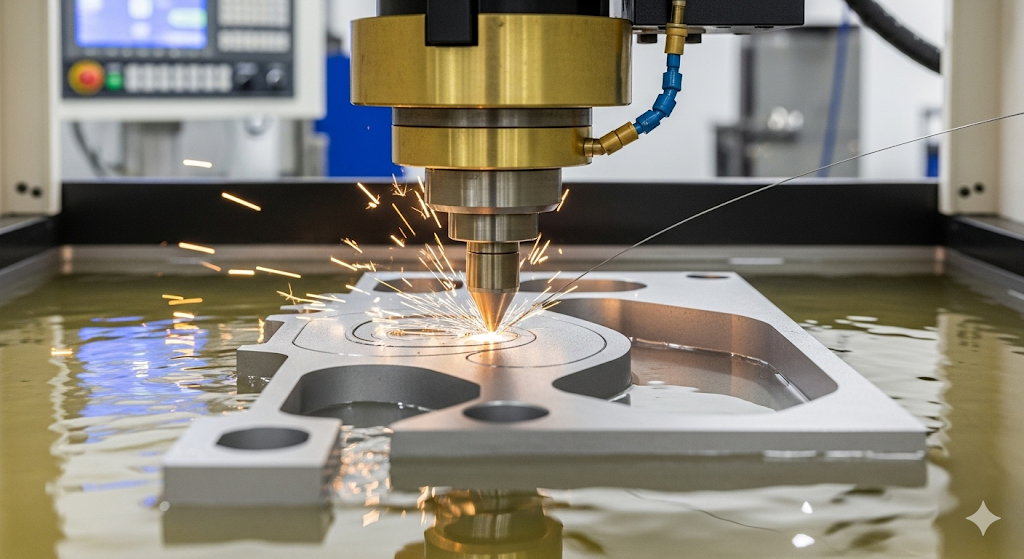
Wire EDM uses a continuously fed, thin metal wire—typically brass or molybdenum—as the tool electrode. The wire traverses a programmed path, creating precise contours with tolerances often within ±0.001 mm. Ideal for aerospace turbine blades, medical implants, and micro-mechanical parts, wire EDM’s spark erosion produces narrow kerfs and minimal heat-affected zones. It accommodates hard alloys like titanium, Inconel, and tungsten carbide, making it indispensable for applications demanding geometric complexity and exceptional surface quality.
Sinker EDM
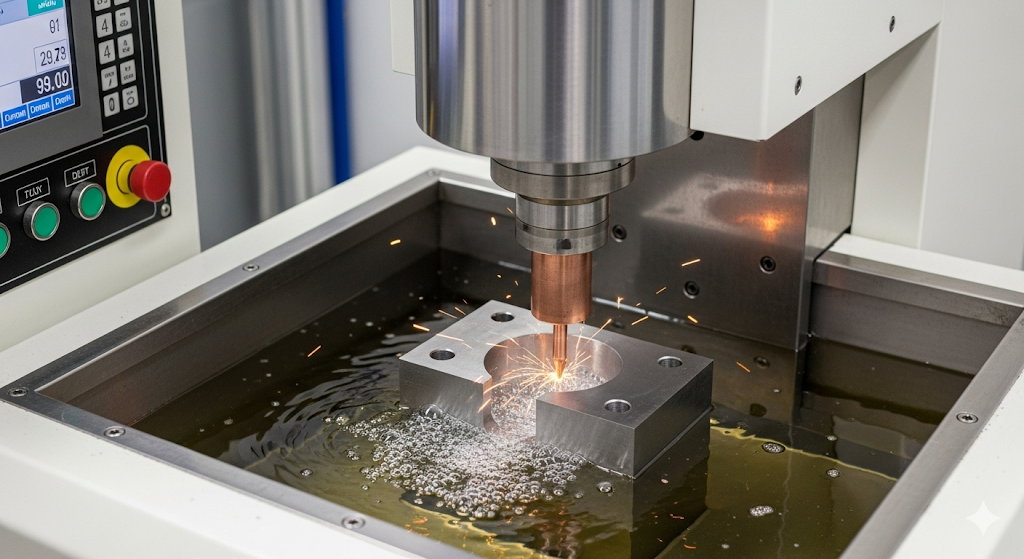
Sinker EDM, also called ram or cavity EDM, employs custom-shaped graphite or copper electrodes that “sink” into the workpiece to reproduce three-dimensional cavities. This process excels at fabricating molds, dies, and deep ribs with sharp inside corners that are unachievable by milling. The dielectric fluid—often deionized water or oil—flushes eroded particles while controlling spark intensity. Manufacturers rely on sinker EDM for tooling in injection molding, die casting, and pressure die applications where intricate internal geometries and high hardness materials prevail.
Hole Drilling EDM
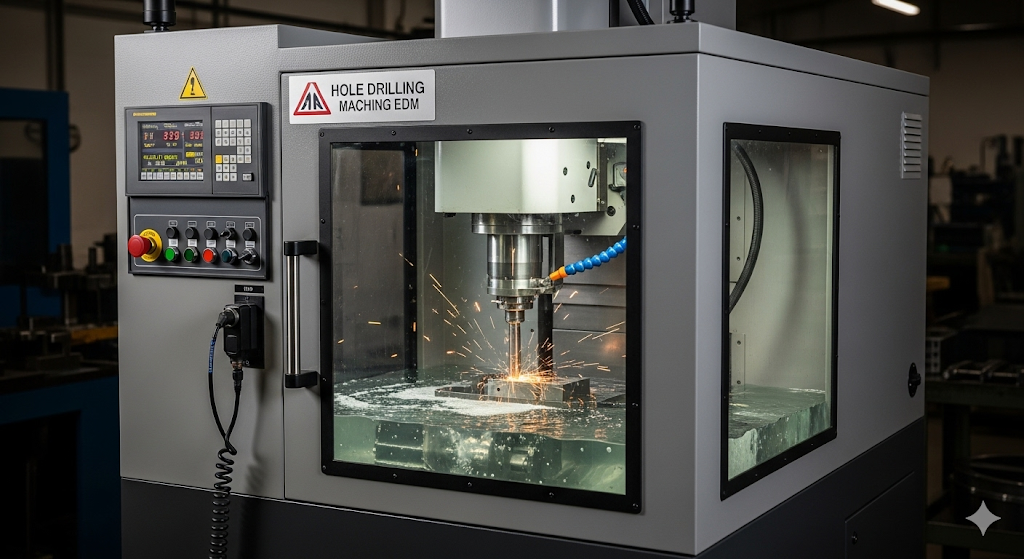
Hole drilling EDM deploys a rotating tubular electrode, usually brass or copper, to drill micro-holes as small as 0.1 mm in diameter. Rapid electrical discharges erode the workpiece at the electrode tip, while dielectric fluid circulates through the tube to evacuate debris and cool the hole walls. Ideal for fuel injection nozzles, cooling channels in turbine blades, and fine microstructure features in medical devices, hole drilling EDM achieves high aspect ratios with unmatched concentricity and roundness compared to conventional micro-drills.
How to select the right EDM method for a specific application?
When selecting EDM method, engineers weigh material characteristics, part geometry, tolerance requirements, and production volumes. Conductive hardness dictates whether spark erosion or conventional machining is more efficient—EDM outperforms when the material exceeds HRC 50 or contains abrasive inclusions. Part complexity informs the choice: wire EDM handles external contours and fine slots, sinker EDM sculpts internal cavities, and hole drilling EDM creates precise micro-holes. Production speed and electrode wear also factor in, as copper electrodes excel in sinker operations, while brass wires minimize breakage in continuous cuts.
To facilitate method selection, practitioners often conduct feasibility studies that simulate erosion rates, thermal impact, and dielectric management. Process simulation software can predict spark behavior and electrode consumption, reducing trial-and-error in tooling design. Ultimately, the ideal EDM strategy balances cycle time, electrode cost, and surface integrity to meet project deadlines and quality standards.
| Selection Criteria | Wire EDM | Sinker EDM | Hole Drilling EDM |
| Typical Tolerance | ±0.001 mm | ±0.005 mm | ±0.01 mm |
| Feature Geometry | External contours | Internal cavities | Micro-holes |
| Electrode Material | Brass, molybdenum | Copper, graphite | Brass tube |
| Throughput | Moderate | Lower | High for small diameters |
| Ideal Applications | Turbine blades, dies | Injection molds, dies | Fuel nozzles, cooling holes |
What materials and industries benefit most from these EDM machining services?
EDM machining services cater to sectors where precision and hardness challenge conventional methods. Aerospace, medical, automotive, and tool-and-die industries exploit EDM for parts made of hardened tool steels, superalloys, carbide, and refractory metals. Aerospace components like fuel nozzles, turbine shrouds, and micro-valves rely on hole drilling EDM for cooling passageways. Medical device manufacturers use wire EDM to produce cardiac stents, orthopedic implants, and surgical micro-instruments with biocompatible alloys. Tool shops apply sinker EDM to sculpt high-volume injection molds and extrusion dies from P20, H13, and stainless tool steels.
EDM’s ability to deliver exceptional surface finish—down to Ra 0.1 µm—and maintain complex geometries has sparked innovations in microfluidics, micro-mechatronics, and micro-optics. Emerging applications include electric vehicle motor laminations, semiconductor wafer carriers, and micro-nozzles for battery cooling.
What does the EDM process look like from start to finish?
The EDM workflow begins with part design, typically in CAD, followed by CAM programming to define spark parameters, electrode paths, and dielectric flow. For wire EDM, engineers generate a 2D profile program; sinker EDM demands 3D electrode models; hole drilling EDM uses parametric cycles for depth and diameter. Next, electrodes are fabricated—graphite for cavities, brass wire for cuts, or tubular electrodes for holes. The machine setup aligns workpiece, secures fixtures, and calibrates dielectric filters and pumps.
During operation, servo systems maintain precise gap control between electrode and workpiece, modulating voltage and current to generate consistent sparks. The dielectric fluid flushes eroded particles, preventing secondary discharges and ensuring surface integrity. Post-machining, parts undergo cleaning, deburring, and quality inspection using CMMs or optical comparators. Optimal EDM routines balance spark energy, pulse on/off times, and flushing pressure to minimize electrode wear and maximize MRR (material removal rate).
How wire EDM vs sinker EDM influences cost and efficiency
Comparing wire EDM vs sinker highlights differences in electrode preparation, cycle time, and material removal rate. Wire EDM’s continuous cutting requires minimal electrode setup beyond wire threading and tensioning. In contrast, sinker EDM demands custom electrode fabrication, which adds lead time and costs. Hole drilling EDM typically offers the fastest cycle for each orifice but requires specialized power supplies to maintain high-frequency discharges.
Efficiency also varies by feature volume. Large cavities consume electrode material quickly, tipping cost-benefit toward sinker EDM for low volumes. High-precision external cuts favor wire EDM for repeatability and low consumable usage. For micro-hole arrays, hole drilling EDM’s rapid drilling cycles offset electrode tube costs, making it the method of choice for intricate perforated components.
| Method Comparison | Electrode Prep | Consumable Cost | Cycle Time | Ideal Volume |
| Wire EDM | Low | Moderate | Moderate | Medium to high |
| Sinker EDM | High | High | Longer per cavity | Low to medium |
| Hole Drilling EDM | Moderate | Moderate | Short per hole | High micro-hole arrays |
Key considerations when selecting EDM machining services
Selecting EDM machining services requires evaluating provider capabilities: machine models, dielectric systems, electrode fabrication, and programming expertise. Facilities equipped with high-pulse generators, multi-axis wire EDM, and automation for electrode changeover deliver faster turnaround and tighter tolerances. Quality management, including SPC (statistical process control) and ISO 9001 compliance, ensures consistency across large production runs. A supplier’s experience with complex part geometry and material science reduces development risk.
In addition, service providers must offer post-process support: comprehensive job documentation, reverse-engineering services, and secondary operations like polishing, heat treatment, or surface coating. Collaborative engineering during design-for-manufacture (DFM) phases can optimize electrode paths and reduce electrode wear, enhancing both quality and cost-effectiveness.
Our website offers a comprehensive overview of edm machining services, including technical guides and case studies to guide selections.
Safety and environmental factors in EDM machining services
Although EDM is non-contact, operators must manage high voltages, dielectric fluids, and fine particulate waste. Proper grounding, spark detection, and dielectric filtration systems prevent electrical hazards and reduce fire risk. Facilities must handle spent dielectric safely—oil-based fluids require recycling or disposal per environmental regulations, while deionized water systems may demand treatment for metal ions. Advanced EDM centers implement closed-loop filtration and mist-control units to protect operator health and maintain optimal spark conditions.
Integrating EDM into a full manufacturing workflow
EDM machining services can seamlessly integrate with CNC milling, laser cutting, and additive manufacturing to produce hybrid components. Designers might rough-mill bulk geometry, then apply EDM for finishing intricate details. Additive-manufactured metal preforms benefit from EDM to refine microfeatures or remove support structures. This synergy maximizes productivity, reduces material waste, and enables complex designs that surpass the limitations of any single technology.
Our production line employs cross-functional teams to orchestrate multi-process sequences, ensuring single-point responsibility and rapid iteration from prototype to production.
In many cases, engineers consult what is EDM machining resources to determine the most efficient process flow and design constraints.
Common challenges and troubleshooting tips
EDM machining services face challenges like wire breakage, unstable arcs, electrode wear, and taper in deep cavities. To mitigate wire EDM breakage, optimize spark gap voltage, wire tension, and dielectric conductivity. For sinker EDM, employ staged roughing and finishing cycles to preserve electrode life and prevent over-erosion. Hole drilling EDM benefits from pulsed flushing and rotational motion to clear debris in deep holes and maintain concentricity. Regular maintenance of filters and dielectric quality prevents arcing anomalies and surface defects.
Case study: High-precision micro-nozzles for aerospace
A leading aerospace OEM required an array of 0.2 mm holes in a nickel-based superalloy manifold. Conventional drills failed due to tool deflection and material work-hardening. Our facility employed hole drilling EDM with a brass tubular electrode, achieving ±0.005 mm hole diameter tolerance and Ra 0.3 µm surface finish. The optimized cycle used high-frequency pulses and through-tool flushing to maintain debris evacuation. Production yield exceeded 98%, enabling on-time delivery for the engine assembly line.
Conclusion
In 3rd person analysis, EDM machining services deliver unmatched precision for applications too demanding for mechanical cutting. Wire EDM, sinker EDM, and hole drilling EDM each offer unique strengths: external contouring, cavity formation, and micro-hole creation. Selecting the right method hinges on material hardness, geometry complexity, tolerance requirements, and production volume. Leading providers combine advanced generators, multi-axis machines, and robust dielectric management to meet stringent quality standards. For enterprises seeking comprehensive EDM solutions backed by engineering expertise, integrity tool inc stands ready to partner on projects of any scale. Readers ready to harness the full potential of EDM should contact us to explore tailored capabilities and accelerate their manufacturing innovation.
With process integration, collaborative DFM support, and rigorous quality control, EDM machining services continue to push the boundaries of precision engineering. Trust Integrity Tool Inc for turnkey EDM expertise, from prototype micro-features to high-volume production runs.
Frequently Asked Questions
What is electrical discharge machining and how does it work?
Electrical discharge machining (EDM) uses controlled electrical sparks to erode conductive materials without mechanical force. An electrode and the workpiece are submerged in dielectric fluid. When a voltage is applied, the spark bridges the gap, melting microscopic areas on the workpiece. The dielectric fluid then flushes away the molten particles, gradually forming the desired shape.
How do wire EDM and sinker EDM differ in applications?
Wire EDM cuts external profiles with a thin wire, ideal for contours and slots in hardened materials. Sinker EDM uses shaped electrodes to reproduce internal cavities and complex 3D forms. Wire EDM delivers tighter tolerances on edges, while sinker EDM excels in deep cavities and sharp inside corners.
When should hole drilling EDM be chosen over conventional drilling?
Hole drilling EDM is preferred for holes below 0.5 mm diameter or deeper than ten times the diameter where drill runout and breakage become critical. It ensures precise roundness and concentricity in hard or work-hardening materials that challenge twist drills and micro-drills.
What factors influence the cost of EDM machining services?
Key cost drivers include electrode fabrication, material removal rate, cycle time, and consumable wear. Complex geometries that demand custom electrodes or multiple machining stages increase setup costs. High-volume micro-hole arrays may offer economies of scale through optimized hole drilling EDM cycles.
How can engineers optimize spark parameters for better surface finish?
Surface finish improves with lower pulse energy, shorter pulse duration, and controlled dielectric flushing. A fine-finish cycle typically uses low peak current and rapid on-off pulses. Polarity reversal and electrode rotation can also refine surface texture by distributing spark impact evenly.
Our technical resources profile EDM Machining Services Used in diverse industries, showcasing best practices and optimized workflows.